
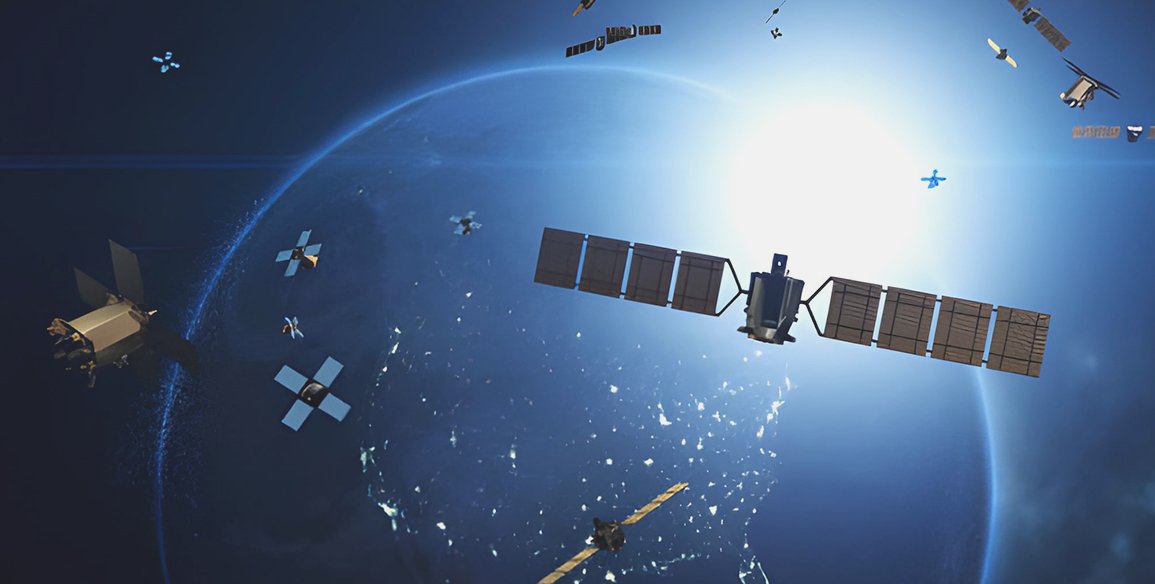
Satellites That Think: The Evolution of Onboard AI Decision-Making in Space
 Facebook
 Twitter
 LinkedIn
 WhatsApp
Not too long ago, satellites were primarily compliant devices. They followed the instructions sent from Earth, collected the needed data, and waited patiently for the next command. Each modification, every choice, and all corrections were to originate from ground control, often experiencing delays of several minutes or even hours.
Today, that is changing fast; evolution is taking place, and it will not spare a single thing. And it’s because of artificial intelligence in satellites that modern spacecraft are beginning to think, decide, and act on their own.
Why Satellite Needed to Get Smarter
Earlier space missions were simpler; hence, fewer things to do, but today, the missions are getting more complex. The old ways of managing satellites have reached their limit. The delay in communication is making real-time decision-making difficult, especially for satellites that operate far from Earth.
Modern satellites are generating a massive amount of data, far more than humans can manually sort through. Furthermore, the rise of satellite constellations, where hundreds and thousands of satellites are working together, makes it clear why automation alone will not work. More than instructions, satellites need intelligence.
This need ignited the advancement of Artificial Intelligence in satellites, so spacecraft can evaluate circumstances and react immediately, without delay.
From Simple Automation to True Onboard Intelligence
Early satellites relied on fixed rules: “If this happens, do that.” These systems worked, but they couldn’t adapt. AI changed that by introducing learning-based models that improve over time.
Advances in onboard computing, lightweight processors, and machine learning methods enabled AI to be operated directly in space. Satellites can now decide what's crucial, when to act, and how to optimise their own operations, instead of sending raw data back to Earth for evaluation, making it easy for people on Earth.
This shift marks the true evolution from passive space hardware to active decision-makers.
How Onboard AI Actually
AI-powered satellites run on a simple loop. Satellite Sensors acquire images, temperature measurements, motion data, and system health information. Onboard AI algorithms analyse this data in real time, comparing it to previously learned patterns or mission objectives.
If something significant is found, the satellite can act right away. This could involve altering its orbit, focusing on specific images, or notifying other satellites— all without needing human help.
Core Applications of Onboard AI
One of the most important uses of AI in satellites is autonomous navigation. Satellites can adjust their position, manage fuel more efficiently, and avoid potential collisions with space debris.
In Earth observation, AI assists satellites in determining which images are valuable to capture and send. Rather than transmitting thousands of unnecessary photos, the satellite can concentrate on events like wildfires, floods, deforestation, or changes in urban areas.
AI also plays a major role in space situational awareness. Satellites can detect objects nearby and react quickly, eliminating the risk of collisions in increasingly crowded orbits.
Another critical application is system health monitoring. AI can identify early signs of equipment failure and sometimes even correct issues on its own, extending mission lifespans and reducing repair costs.
Notable Missions and Initiatives
Several space agencies and enterprises are currently implementing artificial intelligence in satellites. NASA has conducted tests on AI-powered Earth observation missions, which allow satellites to pick when and where to image. The European Space Agency has tested onboard machine learning for ecological tracking and disaster response.
Commercial satellite operators are also utilising artificial intelligence to efficiently operate large constellations. Onboard intelligence is crucial for achieving defence and security objectives such as monitoring, threat identification, and rapid response.
These initiatives show that AI in space is not just for theory; it’s already operational.
Why This Technology Is a Game-Changer
Speed is the biggest advantage of AI. Decisions that once took several hours can now be made quickly. This is critical for time-sensitive applications such as disaster detection and collision avoidance.
AI reduces operational costs too by minimising the need for constant human oversight. Satellites become more efficient, reliable, and independent.
Most importantly, AI improves the quality of data we receive. Instead of overwhelming analysts with raw information, satellites deliver insights that actually matter.
Future Outlook and Challenges
Looking ahead, the future of Artificial Intelligence in satellites points toward fully autonomous networks—satellite swarms that coordinate with each other, share intelligence, and adapt collectively.
However, troubles persist. AI systems must be extremely reliable since spatial inaccuracies are difficult to remedy. Cybersecurity is another challenge, as intelligent satellites must be protected from interference.
Ethical concerns and international legislation will influence how autonomous space systems are deployed. Trust, testing, and transparency will be key as satellites gain more decision-making power.