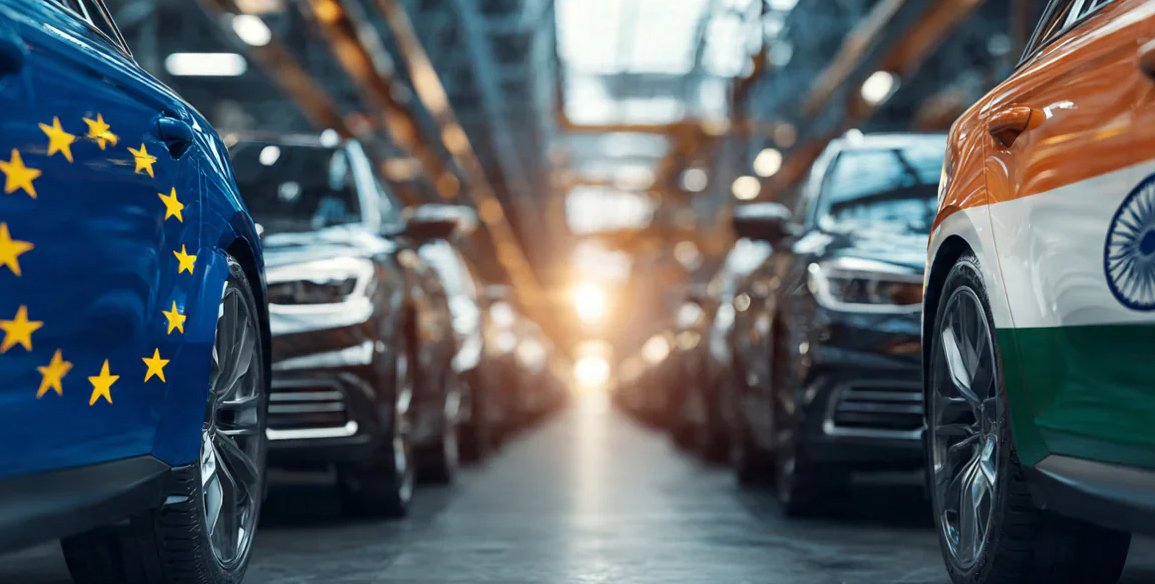
European Carmakers Double Down on Local Production Ahead of India-EU Trade Deal
 Facebook
 Twitter
 LinkedIn
 WhatsApp
Summary: Brands like Volkswagen and Mercedes encourage local manufacturing to build ties with India, citing tariff changes.
Several major European carmakers are increasingly shifting production to India, even as an India-EU free trade agreement (FTA) looms that could lower import duties on foreign cars. Companies including Volkswagen, Mercedes-Benz, BMW, Renault, and Jaguar Land Rover are moving beyond simple imports and boosting local assembly or manufacturing to demonstrate a long-term commitment to one of the world’s fastest-growing auto markets.
Right now, tariffs on imported fully-built cars in India can exceed 110 per cent, a structure that has historically protected local and Japanese brands. Under the proposed India-EU FTA, those duties are expected to drop to around 40 per cent, a substantial reduction though still higher than many other markets.
Rather than waiting for trade liberalisation, European automakers have been assembling imported kits locally, benefitting from a lower tariff of about 16.5 per cent on such “complete knocked down” units. They see this as a way to establish a foothold and build confidence among Indian customers and partners ahead of tariff changes.
Industry experts say this strategy isn’t just about tariffs. Having production capacity in India shows dealerships, suppliers, and buyers that an automaker is serious about India and not just testing the waters with pricey imports. Local production aligns with India's goal of generating employment and enhancing the supply chain.
Many brands have taken major steps: Mercedes-Benz's Chakan factory in Pune produces models like the Mercedes-Maybach GLS, and BMW produces the majority of its lineup in India. These steps have sometimes translated into price reductions compared with imported vehicles, showing how localisation can directly benefit customers.
The prospective FTA adds another element to this pressure. With tariffs expected to decrease further under the agreement, automakers may find it easier to import a wider choice of models and evaluate demand before investing any more in Indian manufacturing. That could accelerate local manufacturing of premium, electric and niche vehicles — segments where European brands traditionally compete.
Still, challenges remain. Even with lower tariffs, European marques make up less than 4 per cent of India’s roughly 4.4 million annual car market, dominated by homegrown and Japanese companies such as Suzuki, Tata and Mahindra. To expand beyond niche premium segments, European players will need not just tariff relief but also competitive pricing and deeper localisation in components and production.
For now, the combined strategy of building locally while preparing for tariff reductions reflects a bet on India’s long-term growth. As the trade pact edges closer to reality, Europe’s automakers are positioning themselves not just as exporters but as long-term partners in India’s automotive development — ready to compete across segments as demand evolves.