
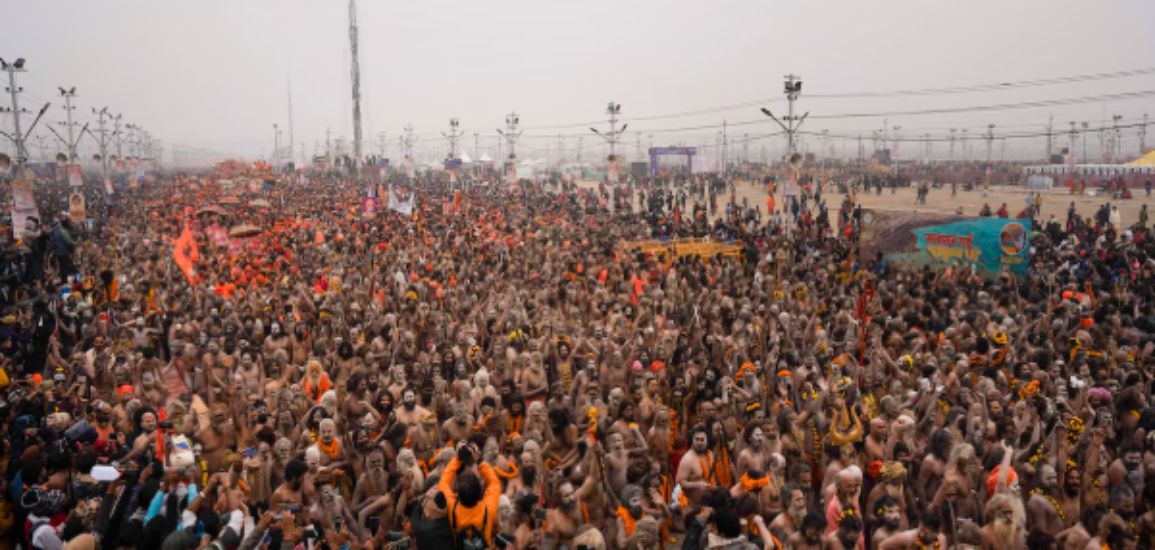
Mahakumbh ‘Amrit Snan’: Akharas begin "Amrit Snan" after the stampede.
 Facebook
 Twitter
 LinkedIn
 WhatsApp
Summary: The Akharas begin "Amrit Snan" under supervision after the stampede.
The last Amrit Snan on Makarsankranti turned out to be horrific, in which at least 30 people died, Akharas kicked off the third "Amrit Snan" at Maha Kumbh Mela in Prayagraj, Uttar Pradesh, this Monday.
This amrit snan came on the occasion of Basant Panchami. After meeting with the leading sadhus of the akharas, the mela administration settled on a bathing schedule to guarantee a safe event. The first group finished the ritual and returned to their camps around 8.30 am, with each akhara having a 40-minute window at the holy waters.
Mahanirvani and Atal Akharas left the camps at 4 am, with the expectation that they would finish the bathing by 5.40 am, rather than leaving the camps at 5.15 am as they did on Makar Sankranti on January 14, amid mounted police officers closely monitoring Sangam Nose in Maha Kumbh Nagar in Prayagraj.
Images of the third 'Amrit Snan' of Maha Kumbh 2025 revealed 'Mahamandleshwars,' or chiefs of several akharas, leading the processions. Sadhus, including the ash-smeared Nagas from different akharas, started their ceremonial march towards the Triveni Sangam at the crack of dawn.
In light of the stampede at Sangam Nose during the previous "Amrit Snan" on "Mauni Amavasya," which claimed at least 30 lives and injured 60 more, the holy bathing practice of Basant Panchami is especially significant.
Since other ghats are equally important, the Uttar Pradesh administration and the akharas have advised visitors not to prioritize getting to the main confluence point, where the stampede occurred. Many people believe that the Sangam Nose has more spiritual significance.