Trump’s Caribbean Military Build-Up Narrows Options on Iran
 Facebook
 Twitter
 LinkedIn
 WhatsApp
Summary: US warship deployment to the Caribbean reduces immediate strike capacity against Iran.
A significant realignment of the United States military to the Caribbean is now limiting how quickly and easily the Pentagon could carry out major military action against Iran, according to defence officials and military analysts.
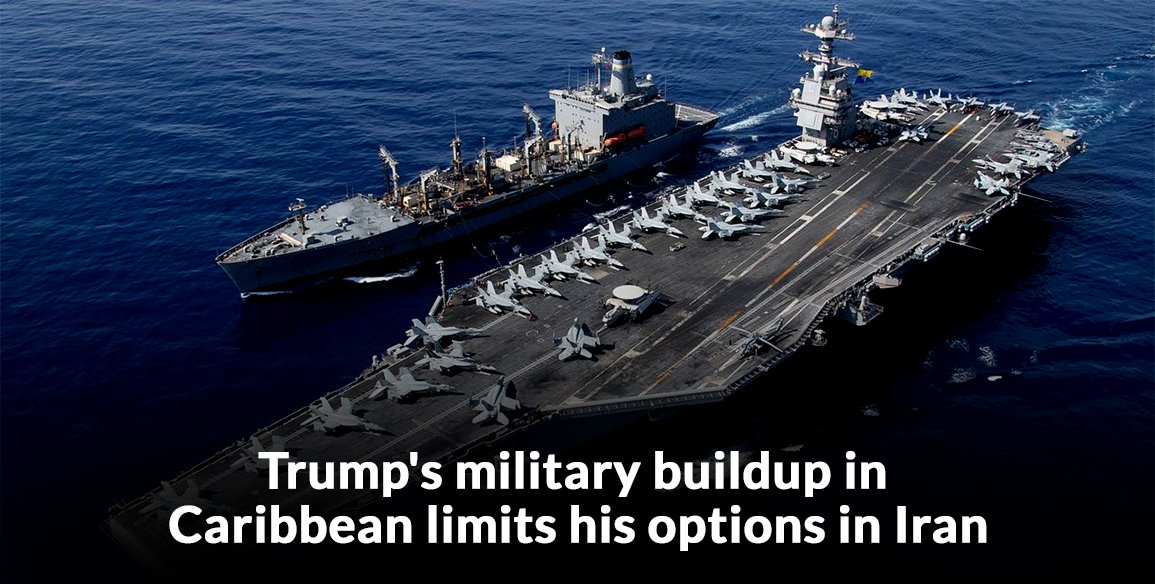
Earlier this fall, President Donald Trump ordered a large contingent of U.S. naval forces — including the USS Gerald R. Ford aircraft carrier and its strike group — to the Caribbean. The build-up was part of a campaign focused on pressure against Venezuela’s leadership and countering regional instability. As a result, far fewer American naval assets are now positioned in the Middle East compared with previous standoffs with Tehran.
Currently, the Pentagon has roughly 12 warships in Caribbean waters, while only about six remain in the Middle East, and no aircraft-carrier strike group is stationed close to Iran. The absence of a carrier — along with its associated air wing of fighters, electronic warfare jets and support aircraft — means the U.S. military would face hurdles in rapidly assembling the full force typically needed for a sustained strike package.
Aircraft carriers are more than just floating airfields. They serve as hubs for offensive and defensive operations, provide air cover, and help protect other U.S. forces from missiles or hostile aircraft. Without one nearby, planners say, options for a major attack on Iranian targets would be narrower and slower to execute, especially if an immediate response were required.
That doesn’t mean action is impossible. U.S. officials stressed that long-range bombers, missiles launched from ships or submarines, and forces based in Europe and the Gulf can still be brought into play. But those moves take more time and coordination, weakening the element of speed and surprise that an aircraft-carrier presence normally provides.
White House press briefings have highlighted that military strikes remain “one of many options” under consideration should the situation in Iran — where large protests continue amid a violent government crackdown — deteriorate further. Yet the shift of assets to the Caribbean inevitably complicates planning for higher-intensity operations in the Middle East.
The Caribbean deployment highlights evolving US objectives and the strategic difficulty of responding to numerous global flashpoints at once. With forces tied up offshore Venezuela and assets spread thin, senior defenders acknowledge that choices involving Iran must balance risk, logistics and diplomatic pressures.
Analysts say this configuration leaves the U.S. with fewer ready-to-launch options and could mean non-military avenues — including cyber tools, sanctions or diplomatic pressure — become more prominent in Washington’s toolkit if tensions with Tehran escalate.