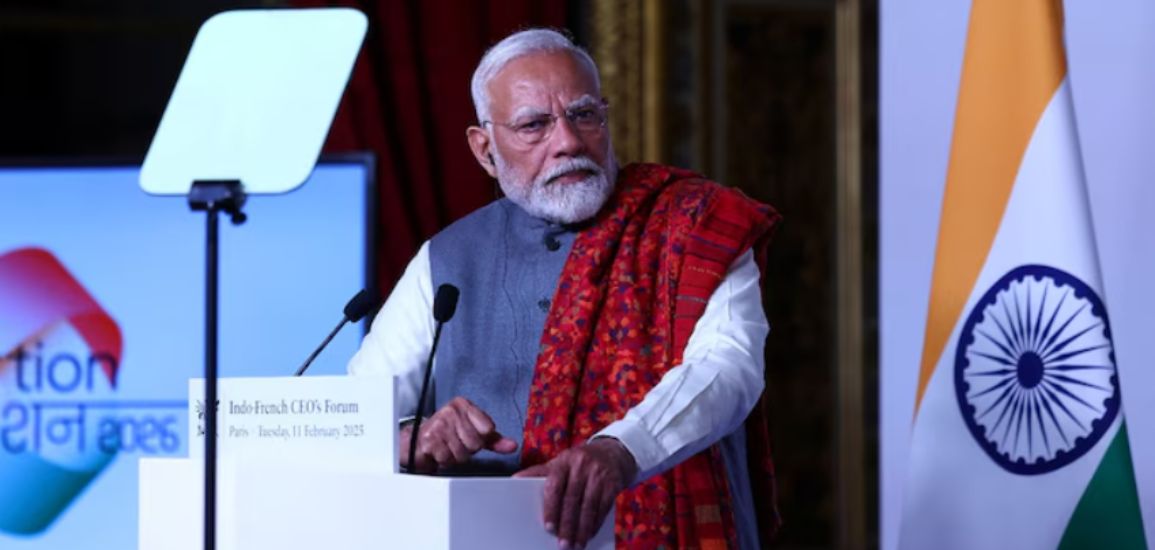
PM Modi at the India-France CEO Forum in Paris.
 Facebook
 Twitter
 LinkedIn
 WhatsApp
Summary: India is emerging as "the biggest center of diversification and de-risking," according to PM Modi.
Prime Minister Narendra Modi addressed the CEOs in France by listing the actions India has made to streamline compliance and make doing business easier.
He encouraged French businesses to work with India in fields like technology, innovation, and sustainable development, and to take advantage of the country's enormous prospects.
“Let me tell you all, this is the right time to come to India. Everyone’s progress is linked to India’s progress. An example of this was seen in the aviation sector when Indian companies placed large orders for airplanes. And, now, when we are going to open 120 new airports, you can imagine the future possibilities for yourselves,” he said at the India-France CEO Forum in Paris.
According to him, India is emerging as “the biggest center of diversification and de-risking.” “A few days ago, a new generation of reforms were outlined in our budget. New steps have been taken for ease of doing business. In the last few years, we have rationalized more than 40,000 compliances. To promote trust-based economic governance, a high-level committee for regulatory reforms has been formed. The custom rate structure has been rationalized.”
Declaring that the government had allowed 100% international Direct Investment (FDI) in the insurance industry, the prime minister emphasized India's forward-thinking strategy for luring in international capital. He claimed that by taking these actions, India would be able to transition to more effective and sustainable energy sources.
“The insurance sector was now open for 100 percent FDI and civil nuclear energy sector for private participation with a focus on SMR and AMR technologies; customs rate structure was rationalized; and simplified income tax code was being brought in to enhance Ease of Living,” said PM Modi.
The Export Promotion Mission and BharatTradeNet are two initiatives included in India's Union Budget 2025–2026 that aim to lessen compliance costs for both individuals and businesses while also increasing the efficiency of exporters' logistics. Also, it declared that revisions to customs duties will be applied to essential materials, such as the manufacturing of electric vehicles.