Supreme Court Passes Landmark Judgement that Centre's Decision on Demonetization Was Valid
 Facebook
 Twitter
 LinkedIn
 WhatsApp
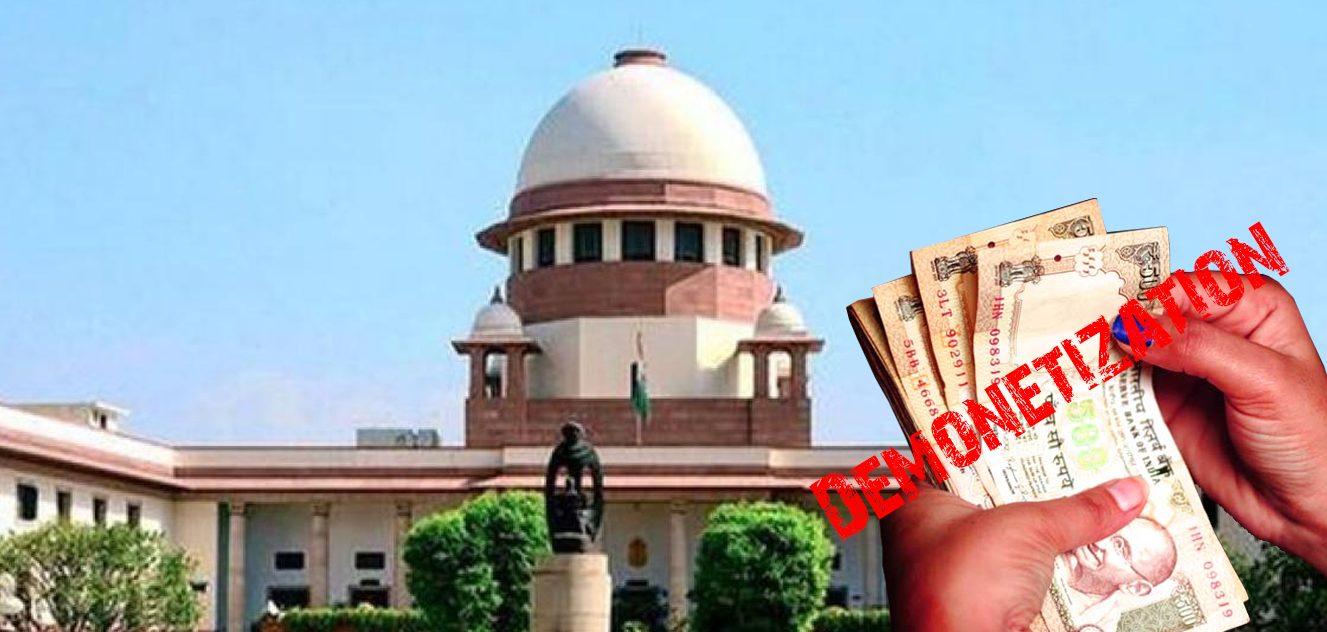
The Supreme Court in its landmark judgment that saw a 4-1 majority, sided with Prime Minister Narendra Modi’s decision in 2016 for demonetization. The event called for an immediate ban on the value of 500 and 1000 INR currency notes. People were given a short time wherein they could deposit hard cash of this denomination to their bank accounts, in exchange for valid currency and new notes.
Recently a petition challenged the shocking move by the PM, which made 86% of finances circulating in the economy redundant and worthless overnight. There were petitions seeking a new window, an expansion to the timeline given to exchange the scrapped notes. According to the judge, the center had consulted with the Central Board of RBI for around 6 months before the action was taken for the note ban.
Out of 5 jurists, 4 consented to PM Modi’s demonetization, while one of the jurists asserted that the move was unlawful. There were two separate judgments by the bench of Justices S Abdul Nazeer, BR Gavai, AS Bopanna, V Ramasubramanian, and BV Nagarathna.
Many people suffered fiscal mishaps as they could not exchange notes in the provided period. Also, several small-scaled businesses and daily wagers who used to receive wages and earnings mostly in cash were taken back by the sudden decision that took effect on 8 November 2016 through 30 December 2016.
Top 10 Things Which the Supreme Court Opined on Currency Ban 2016
Here is what the judge had to say after reviewing the petition and the arguments presented:
1. The central government’s demonetization call as per the consultation bench was a decision-making process, both valid and not faulted with as it was the Centre’s move.
2. The court said that the action had an inbuilt safeguard as the center had consulted the RBI for 6 months on it.
3. The order for implementing demonetization was an exercise that was executed within 24 hours. It was an exercise of power, which is in contrast to the law and unlawful.
4. About 58 petitions challenged the currency ban decision, which wiped Rs. 10 lakh crore out of monetary circulation.
5. Most of the petitions centered around how the center had not considered the impact of the move, which caused immense hardships among the mass, forcing them to queue up for hours outside the bank and ATMs for cash.
6. The government had defended that the court cannot decide on events when there is no granting of any tangible relief, as the demonetization activity was a part of a larger strategy to counter terror financing, the menace of fake money, tax evasion, and black money, and a well-considered move.
7. The Supreme Court also ruled that the note ban had no relevance to the objective being a success or not in the 52 days provided by the government to exchange the INR 500 and 1000 notes, which is not unreasonable. Justice BR Gavai said that the matters of economic policy carry a great restraint and the court cannot supply wisdom to the wisdom of the executive, reflected as sentiment while reading out from the order.
8. However, Justice BV Nagarathna dissented from the currency ban strongly and said that the move was unlawful and vitiated, but the status quo cannot be at the moment, restored as the move was executed as an act of the Parliament.
9. Justice Nagarathna also said that problems that took place with note scrapping make one think if the central bank had visualized the consequences of the decision.
10. She also said that records and documents, which the RBI and Center submitted consisted of phrases such as "As desired by the Central Government", which indicated that the RBI had no independent application of mind in this case.